
What happens when the journal system starts listening
Last updated Sep 27, 2026·5 min read
For decades, journal systems waited to be typed into. The next generation will listen, understand, structure and write - inside the record, not beside it.
For decades, the dental journal stored what dentists typed. That was its whole job.
The next generation of journal systems will do something new. They will listen.
They will hear the appointment and write the note in the clinic's own template. They will fill the perio chart as the dentist calls out the numbers. They will suggest the right codes. They will spot what is missing before the patient leaves.
That changes what a journal is. It stops being a place to store work. It starts doing part of the work.
It also changes where AI belongs. This article is about that second part.
A good note is not the finish line
Most clinical AI can write a good note today. The difference is what happens to the information next.
When AI sits beside the journal, the path looks like this:
Consultation → separate AI tool → copy and re-enter → journal.
When AI is a layer inside the journal, the path is shorter:
Consultation → AI layer → patient record, perio chart, tooth and surface, procedure codes.
Same AI idea. Very different workflow. The first produces text that someone still has to move. The second produces data that is already where it belongs.
Same idea, very different workflow
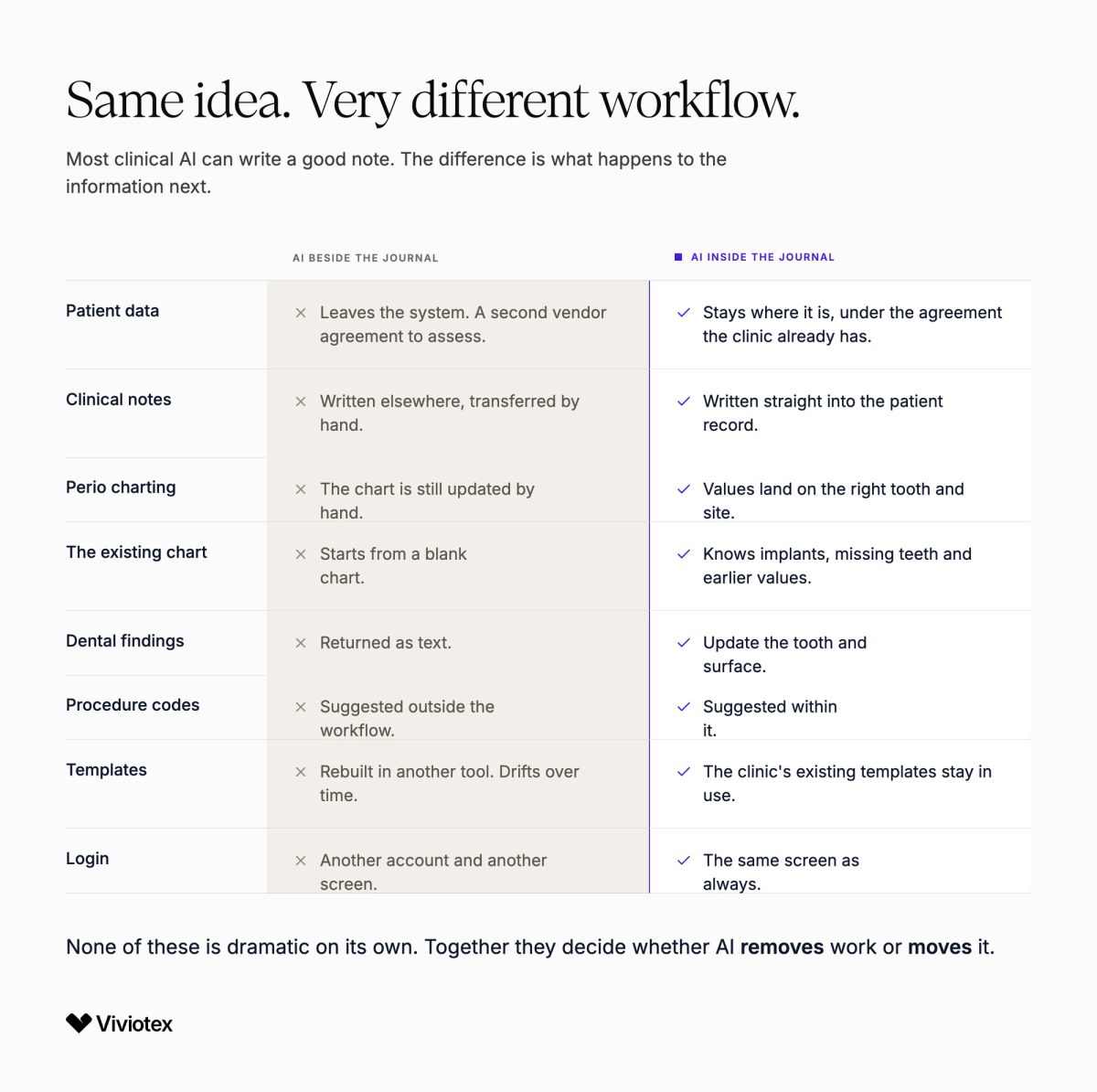
Here is how the two approaches differ, point by point.
Patient data. Beside the journal: leaves the system, and a second vendor agreement to assess. Inside the journal: stays where it is, under the agreement the clinic already has.
Clinical notes. Beside: written elsewhere, transferred by hand. Inside: written straight into the patient record.
Perio charting. Beside: the chart is still updated by hand. Inside: values land on the right tooth and site.
The existing chart. Beside: starts from a blank chart. Inside: knows implants, missing teeth and earlier values.
Dental findings. Beside: returned as text. Inside: update the tooth and surface.
Procedure codes. Beside: suggested outside the workflow. Inside: suggested within it.
Templates. Beside: rebuilt in another tool, drifting over time. Inside: the clinic's existing templates stay in use.
Login. Beside: another account and another screen. Inside: the same screen as always.
None of these is dramatic on its own. Together they decide whether AI removes work or moves it.
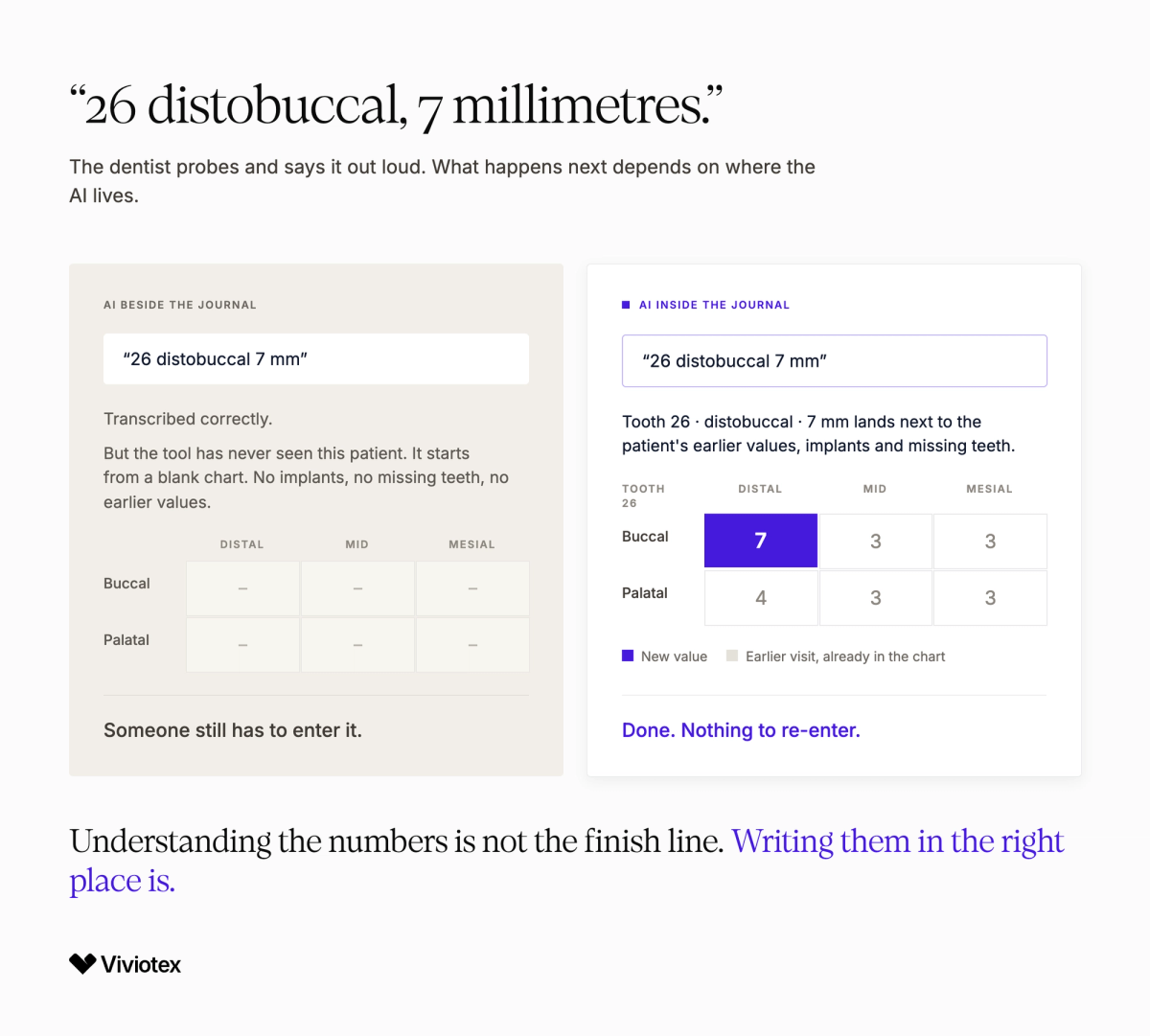
"26 distobuccal, 7 millimetres."
Take periodontal charting. The dentist probes and says: "26 distobuccal, 7 millimetres."
A tool beside the journal transcribes it correctly. But the tool has never seen this patient. It starts from a blank chart. It does not know which teeth are implants or missing. It has no earlier values to compare with. And when it is done, someone still has to enter the number.
A layer inside the journal does something different. The 7 lands on tooth 26, distobuccal site, next to the values from the last visit. Implants and missing teeth are already there. Done. Nothing to re-enter.
Understanding the numbers is not the finish line. Writing them in the right place is.
Every finding belongs somewhere
A note can be copied. Structured clinical data needs to land in the right place.
A crown belongs to a tooth. Caries belongs to a tooth and a surface. A pocket depth belongs to a tooth, a site and a date. A procedure belongs to an encounter.
Stored this way, the data supports treatment history, recall and follow-up. Stored as a paragraph of text in another system, it supports none of that.
This gets harder as AI moves from notes into charting, coding and workflow. Text can live anywhere. Structured data has an address. Only the system of record knows it.
Compliance by default
When patient data leaves the journal, the clinic gains a new data processor. That means a new agreement to review, a new vendor to assess, and a new place where patient information lives.
When the AI runs inside the journal, none of that appears. Patient information never leaves the journal system. In our partner model, the AI is delivered by the journal provider, under the agreement the clinic already has. GDPR sees one record, not two. So does the next inspection.
Nothing new to sign, assess or secure. That is not a feature. It is a consequence of where the AI lives.
VivioDent is GDPR compliant, SOC 2 Type II audited and ISO 27001 certified. But the more important point is simpler: it never asks the clinic to send data anywhere else.
How a listening journal works
The flow has four steps, and none of them happens on a separate screen.
- Listens during the consultation.
- Understands the clinical meaning.
- Structures notes, values, findings and codes.
- Writes to the journal, in the right place in the record.
The clinician reviews and approves. The judgement stays with the dentist. The typing does not.
This is what VivioDent does inside the journal systems we partner with. There is nothing to install and no new login. The AI arrives as a capability of the system the clinic already runs.
For those who build journal systems
This shift is not only a clinic question. It is a platform question.
Your clinics do not need to leave you to get AI. The patient history, the templates and the workflow are already in your system. That is precisely what a separate tool cannot see.
A journal system that listens can reach its whole installed base at once. Clinic by clinic, sale by sale, security review by security review is the slow way. The platform is the fast one.
That is what Viviotex is building. Not another product beside your system. A layer inside it.
AI will change what a journal is
Most people still see dental AI as a separate product clinics buy.
We see it as something the journal simply does.
The journal has spent decades waiting to be typed into. The next one will listen, understand, structure and write. Legacy systems do not need to be replaced for this to happen. They can become AI-native themselves.
The real question is not which AI tool wins. It is which journal systems learn to listen.
We can show you the flow on your own journal view. Talk to us.